Facebook
 X
X
 Pinterest
 Copy Link
Quick Answer
Fullerton ADU rules follow California state law. On most single-family lots, a homeowner can add one accessory dwelling unit (ADU) of up to 1,200 square feet. A junior ADU (JADU) of up to 500 square feet can join it. There is no minimum lot size, and setbacks run four feet. The city reviews a qualifying permit within 60 days, with no public hearing.
Fullerton ADU details verified as of July 6, 2026, against the Fullerton Municipal Code and California ADU law (HCD). Analysis by Michael Mellgren, REALTOR® (DRE #02321556).
What is an ADU, and what is a JADU?
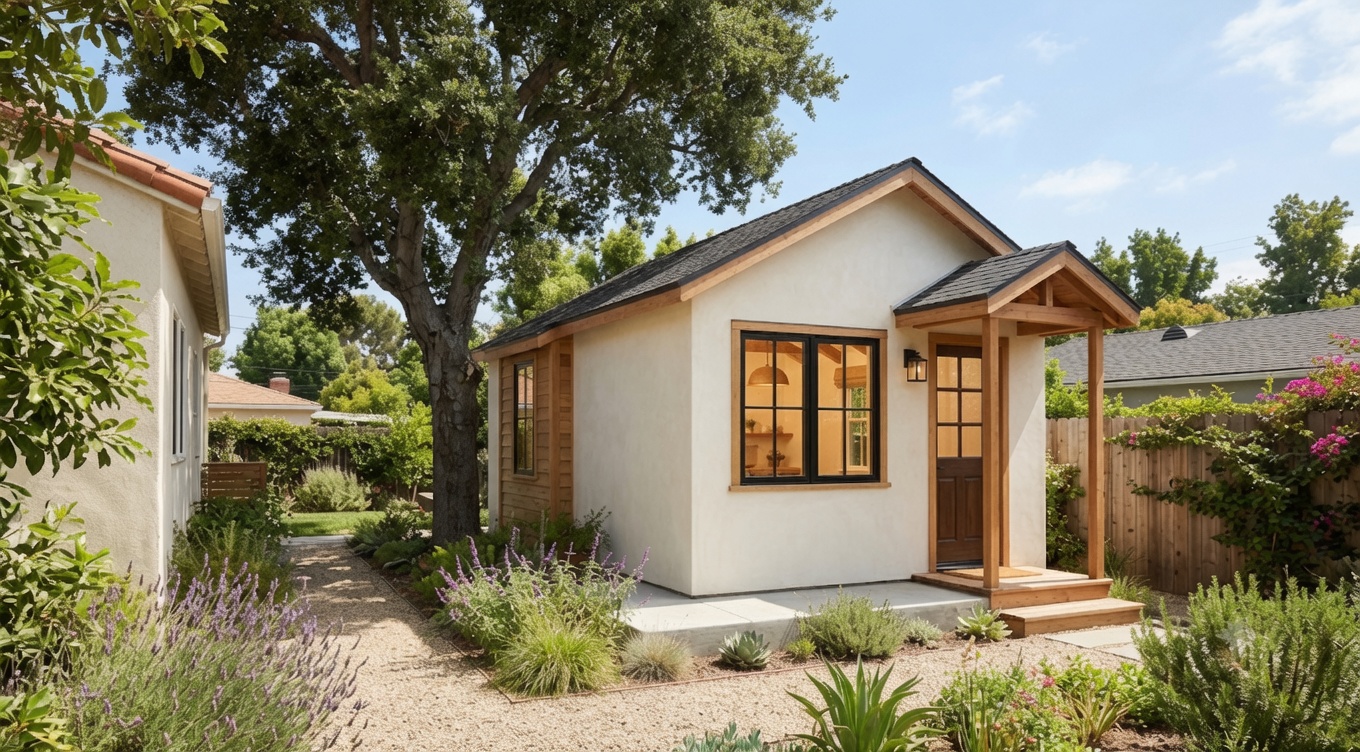
An ADU is a self-contained second home on the same lot as a primary residence. It has its own kitchen, bathroom, and private entrance. You may also hear one called a granny flat, a casita, or a backyard cottage. A JADU is smaller. It fits inside the existing walls of a single-family home, often a converted bedroom or garage, and runs up to 500 square feet. Both add living space without changing the lot’s zoning.
Fullerton allows three ADU forms. A detached unit stands alone in the yard. An attached unit connects to the main house. A conversion turns existing space, such as a garage, into a unit. A JADU is different: it stays inside the home’s footprint, shares systems with the main house, and needs only a small kitchen. It still requires its own entrance, though.
Can you build an ADU on any lot in Fullerton?
Most Fullerton homeowners with a single-family property can build an ADU. Lot size is not the deciding factor. California law bars cities from setting a minimum lot size for an accessory dwelling unit. So a small parcel qualifies the same as a large one. What matters is the zoning and whether the unit meets the size, setback, and height standards below.
On a single-family lot, Fullerton generally allows one ADU plus one JADU. Some properties carry extra review. A home in a historic preservation zone may face design conditions. So can one listed on the city’s local historic register. The reason is simple: the code asks that a unit visible from the street stay compatible with the main home’s look.
What are the size, height, and setback limits for a Fullerton ADU?
A detached Fullerton ADU can reach 1,200 square feet. Side and rear setbacks are four feet. A setback is just the required distance between the structure and the property line. The table below lays out the core standards for each unit type.
| ADU type | Maximum size | Maximum height | Minimum setback (side and rear) |
|---|---|---|---|
| Detached ADU | Up to 1,200 square feet | About 16 feet (higher on some transit-adjacent lots) | 4 feet |
| Attached ADU | 50% of the primary home or 1,200 square feet, whichever is less | Up to 25 feet | 4 feet |
| Junior ADU (JADU) | Up to 500 square feet, within the existing home | Within existing walls | Not applicable |
| Conversion ADU | Existing footprint (plus up to 150 square feet for an entrance) | Existing structure | Exempt |
Fullerton ADU and JADU standards under California state law and the Fullerton Municipal Code, verified July 2026. Source: Fullerton Municipal Code §15.17.100 and California HCD; summary by Michael Mellgren, REALTOR®.
Conversions of an existing garage or structure skip the four-foot setback rule, since they reuse space that already stands. Detached units usually top out at about 16 feet. Certain lots near major transit may go higher. Attached units can rise to 25 feet, or the height limit for the main home, whichever is lower.
How much does an ADU cost to build in Fullerton?
ADU construction in Fullerton commonly runs $150 to $300 per square foot. The real figure swings widely, though, with size, finishes, site conditions, and the builder. City permit and plan-check fees come on top. State law does add one break: an ADU under 750 square feet owes no local development impact fees.
A garage conversion or a JADU is usually the cheapest route, because it reuses an existing structure. A new detached unit sits at the higher end. An ADU also raises property taxes, but generally only on the value of the new unit, not the whole home. For a firm number, get bids from a licensed contractor and confirm current fees with the City of Fullerton. For the tax impact, check with a qualified tax professional.
How do you get an ADU permit in Fullerton?
A Fullerton ADU permit runs through a ministerial process. That means the city approves a compliant application at the counter, with no public hearing or discretionary vote. State law sets a decision deadline of 60 days for a complete application. A 2026 update, Senate Bill 543, adds a 15-business-day window. In it, the city must confirm whether a submission is complete, which curbs open-ended delays.
The path is straightforward. First, confirm the property’s zoning and what it permits. Next, prepare plans that meet the city’s objective standards for size, setbacks, and design. Then submit to the Planning Division and Building and Safety, and clear any plan-check corrections. The legal clock is 60 days, but most owners should plan for three to four months from start to permit.
Fullerton ADU rules: common questions
Do you have to live on the property to rent out an ADU?
No. For an ADU permitted after January 1, 2020, California law bars any owner-occupancy requirement. So an owner can rent out both the main house and the ADU. A JADU differs. Owner-occupancy can still apply, though a 2026 change, Assembly Bill 1154, limits it to JADUs that share a bathroom with the main home.
Can a Fullerton ADU be a short-term rental?
Fullerton ADU rules require any rental to run 31 days or longer. That effectively rules out nightly stays like Airbnb for the unit. The 31-day minimum sits directly in the city’s municipal code.
How many ADUs can one Fullerton lot have?
A single-family lot in Fullerton generally allows one ADU plus one JADU. Multifamily properties follow separate rules. Those depend on the number of existing units and the type of ADU proposed.
Is parking required for a Fullerton ADU?
Often not. California law waives added parking for an ADU within half a mile of public transit, for conversions, and for JADUs, among other cases. Where a space is still required, the city cannot ask for more than one.
Because an ADU decision often ties into a larger move, these Fullerton ADU rules are worth reading next to the current Fullerton housing market and recent Fullerton home price trends.
Weighing an ADU on your Fullerton property?
Whether an ADU pencils out starts with what a specific Fullerton lot and its zoning allow. Michael Mellgren, REALTOR®, follows the local ADU landscape closely. He can help weigh how an accessory dwelling unit might fit a property already owned or under consideration, for any Fullerton address on the list. Email Michael Mellgren about a Fullerton ADU, or call or text (714) 420-6629. For project-specific costs, fees, and approvals, consult a licensed contractor and the City of Fullerton Planning Division.
This post is general information about ADU rules in Fullerton and California, current as of the date shown. It is not legal, tax, or financial advice, and it creates no attorney-client or agent-client relationship. Rules change and apply differently to each property. Confirm the details for a specific situation with the City of Fullerton and a qualified professional before acting.